Conversion guide

Turn your bike into an e-bike: what to check before buying a conversion kit

A practical conversion-kit guide that starts with frame fit, braking, battery quality, route use, and the question of whether the finished bike still matches the kind of riding you want to do.

Last checkedApril 19, 2026
Conversion answer
Start hereStart with fit, brakes, battery quality, and whether the finished bike still matches the ride.

A conversion kit can make sense, but only if the donor bike is worth converting and the finished result still fits the roads, paths, and speeds you actually plan to use. The trap is treating a kit like a cheap shortcut without asking whether the brakes, frame, wheel strength, cargo load, and battery quality are ready for the extra speed and weight.

  • A good donor bike, strong brakes, and a battery from a trustworthy source matter more than peak wattage on the sales page.
  • A converted bike can stop fitting the simple class 1, 2, or 3 answer quickly if speed or throttle behavior changes too much.
  • Budget for tires, brake work, lights, mounts, and tuning rather than the motor kit alone.
  • If the finished bike is meant for family, cargo, or daily transportation, reliability and serviceability beat spec-chasing.
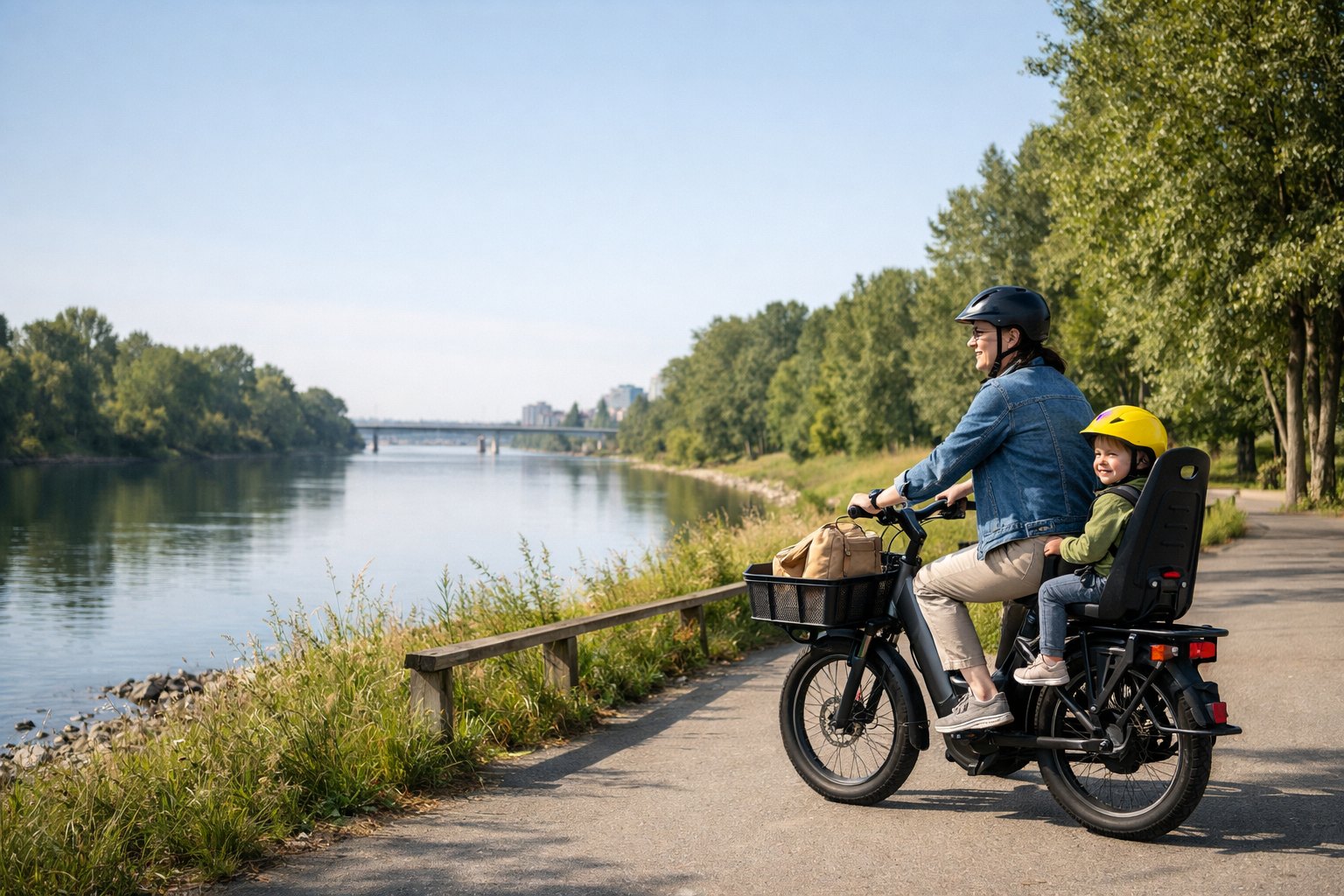
Parent and child riding an e-bike along a riverside corridor.
Most readers arrive with a trip, buyer, or family question and need the answer laid out cleanly.

What this guide covers

Choose the donor bike before the motor

A solid donor bike with reliable brakes, decent wheels, and a frame that already fits the rider is the foundation. If the base bike is flimsy, uncomfortable, or under-braked now, the motor will usually magnify those weaknesses rather than solve them.

Think through the finished bike, not just the kit

The real question is what the completed bike becomes. That includes battery placement, weight distribution, handling, rack space, passenger or cargo plans, and how easy it will be to service later.

  • Front-hub, rear-hub, and mid-drive setups change the ride in different ways.
  • Battery placement can affect step-over height, bag fit, and daily usability.
  • A converted bike still needs lights, fenders, locks, and other practical gear if it has a real transportation job.

Watch the legal category as power and speed climb

The farther a conversion moves from a simple bike with limited assist, the more likely it is to leave the easy e-bike answer riders expect. That matters on multi-use paths, local greenways, and any route where the machine is being judged by behavior as much as by labels.

Battery sourcing is the part to slow down for

Cheap unknown batteries or chargers can erase the savings story fast. The safer move is to buy from a source that can explain the pack, the charger, and the support path if something goes wrong.

Related state pages

Open the exact state pages behind this guide

These state pages carry the official sources and local caveats the guide points readers toward.

FL
Last checkedApril 18, 2026

Florida e-bike laws

Florida generally treats an e-bike and its rider like a bicycle and bicycle rider. That means no state registration or driver-license burden for a standard e-bike, but it does not mean every sidewalk, beach, or path is automatically open.

Class framework
Florida requires a permanent e-bike label showing class, top assisted speed, and motor wattage.
Trail access
Cities, counties, and state agencies may restrict or prohibit e-bikes on bicycle paths, multiuse paths, trail networks, beaches, and dunes.
Open state page
CA
Last checkedApril 18, 2026

California e-bike laws

If the bike really fits Vehicle Code 312.5, California recognizes it as a class 1, 2, or 3 e-bike. But local trail agencies, State Parks, and city rules can still narrow where it can ride, and machines pushed beyond the legal definition can fall into moped, motorcycle, or off-highway rules instead.

Class framework
Vehicle Code 312.5 sets a 750-watt ceiling and defines class 1, 2, and 3. Class 3 is pedal-assist up to 28 mph and must have a speedometer.
Trail access
Local agencies and State Parks may prohibit e-bikes or specific classes on trails under Vehicle Code 21207.5.
Open state page
NY
Last checkedApril 18, 2026

New York e-bike laws

New York allows e-bikes on some streets and highways with posted speed limits of 30 mph or less, does not register them, and lets municipalities control time, place, and manner of operation. That means the state answer is real, but it is not the whole answer.

Class framework
New York DMV defines class 1 and 2 statewide. The class 3 category is a 25 mph class tied to a city with a population of one million or more.
Trail access
DEC allows e-bikes on public roads it manages unless posted otherwise, but off-road use is generally prohibited except in limited designated settings.
Open state page
WA
Last checkedApril 18, 2026

Washington e-bike laws

Washington allows standard e-bikes under a class-based framework, restricts class 3 more tightly on sidewalks and shared-use paths, and pairs that regulatory structure with a statewide e-bike rebate effort.

Class framework
Washington uses class 1, 2, and 3 definitions in RCW 46.04.169 and requires permanent labeling.
Trail access
Class 1 and 2 may use shared-use paths. Class 3 may not. None of the classes belong on natural-surface nonmotorized trails unless specifically allowed.
Open state page