Travel guide

Traveling with or renting an e-bike: what to check before you ride in another state

This guide turns the travel question into a repeatable checklist: check the destination state first, then the route owner, then the rental or bike-category details that can change the answer fast.

Last checkedApril 18, 2026
Trip answer
Start hereTreat out-of-state riding as a destination-state and route-owner question first.

The safest fast answer is not 'my home-state rule probably carries over.' It is 'open the destination state page, figure out whether the trip is street, trail, sidewalk, beach, boardwalk, or park riding, and only then decide whether your own bike or a rental fleet bike fits the route.'

  • Start with the destination state's statewide class and access baseline, not your home state's rule.
  • Then check the local route owner if the trip touches trails, boardwalks, beaches, campuses, or park property.
  • Rental fleets tend to be easier when they stay inside clearly labeled class 1 or class 2 bikes.
  • If your own machine is moped-style, throttle-heavy, or outside class 1, 2, or 3, do not assume a tourist town will treat it like a standard rental bike.
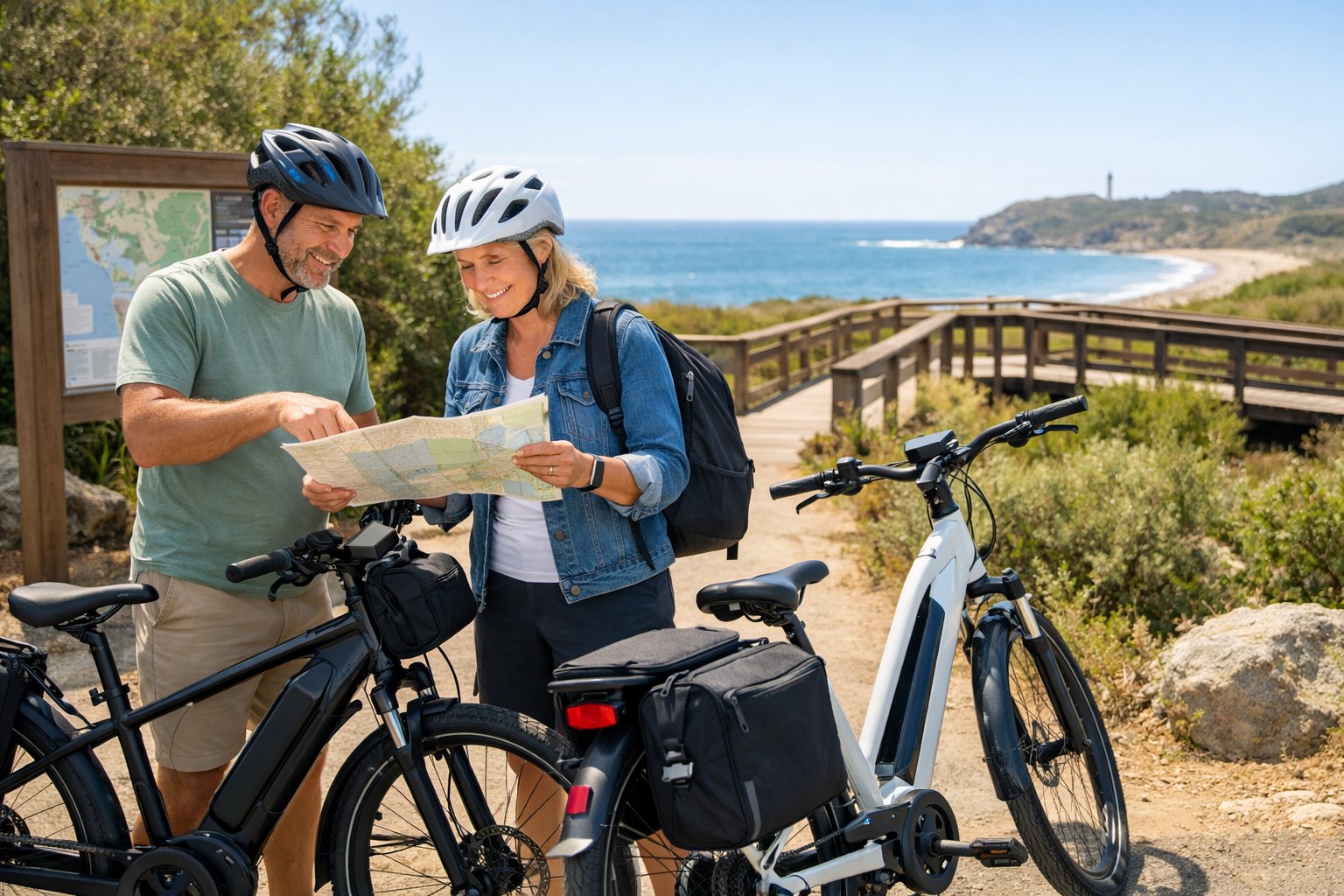
Travelers reviewing a route beside coastal rental-ready e-bikes.
Travel reads work best when the route, rental fit, and state page stay connected.

What this guide covers

Start with the destination, not your home-state habit

State-by-state differences on sidewalks, class 3, youth riding, and trail access can turn a routine ride at home into a restricted ride somewhere else. Travelers need the destination page first because that is where the controlling statewide answer lives.

The route owner often matters more than the bike shop

The hardest travel mistakes usually happen on mixed-use paths, beachfront corridors, greenways, and parks. A rental shop can hand you a legal bike and the route can still be governed by a city, county, campus, or land manager that narrows access.

  • Street and ordinary bike-lane trips are usually the clearest travel use case.
  • Trails, boardwalks, beaches, and natural-surface routes need one extra local or land-manager check.
  • If the trip depends on sidewalk riding, treat it as a likely local-rule issue until proven otherwise.

Why rentals can be easier than bringing your own gray-area bike

A visitor using a labeled rental fleet bike usually starts from a cleaner legal position than a rider arriving with a modded bike, a high-speed throttle machine, or an e-moto-style device. That does not guarantee route access, but it lowers classification confusion.

  • Ask what class the rental bikes are and whether they are limited to class 1 or class 2.
  • Ask whether the rental company has route restrictions of its own, especially around beaches, trails, or boardwalks.
  • If you are bringing your own bike, confirm wattage, top assisted speed, and whether the machine still fits the destination state's e-bike definition.

A better pre-trip workflow

The best workflow is simple: compare the two states, open the destination law page, check the route type, and then decide whether to bring your own bike, rent locally, or choose a different route entirely.

Related state pages

Open the exact state pages behind this guide

These state pages carry the official sources and local caveats the guide points readers toward.

CO
Last checkedApril 18, 2026

Colorado e-bike laws

Colorado uses the standard three-class system, exempts e-bikes from registration and licensing, allows class 1 and 2 on the same bicycle and pedestrian paths as regular bikes unless restricted, and keeps class 3 more limited.

Class framework
Colorado uses the standard class 1, 2, and 3 system and requires a visible label with class, top assisted speed, and wattage.
Trail access
Unless otherwise restricted, class 1 and 2 may use the same bicycle and pedestrian paths as regular bikes. Class 3 may not unless the path is within a street or highway or the local jurisdiction permits it.
Open state page
FL
Last checkedApril 18, 2026

Florida e-bike laws

Florida generally treats an e-bike and its rider like a bicycle and bicycle rider. That means no state registration or driver-license burden for a standard e-bike, but it does not mean every sidewalk, beach, or path is automatically open.

Class framework
Florida requires a permanent e-bike label showing class, top assisted speed, and motor wattage.
Trail access
Cities, counties, and state agencies may restrict or prohibit e-bikes on bicycle paths, multiuse paths, trail networks, beaches, and dunes.
Open state page
IL
Last checkedApril 18, 2026

Illinois e-bike laws

Illinois treats a legal low-speed electric bicycle much like a bicycle on streets, roads, and bike lanes, allows bicycle-path access unless the local authority prohibits it, bars sidewalk riding statewide, and limits class 3 operation to riders age 16 or older.

Class framework
Illinois Vehicle Code 1-140.10 uses the familiar class 1, 2, and 3 system, caps legal low-speed electric bicycles at 750 watts, and says a low-speed electric bicycle is not a moped or motor driven cycle.
Trail access
A rider may use a bicycle path unless the municipality, county, or other local authority with jurisdiction prohibits low-speed electric bicycles or a specific class on that path.
Open state page
MN
Last checkedApril 18, 2026

Minnesota e-bike laws

Minnesota generally lets electric-assisted bicycles operate as bicycles on roads, lanes, and routes, allows class 1 and 2 on many bicycle paths and trails unless a controlling authority prohibits them, allows class 3 on those facilities unless the authority prohibits it, and bars operation by anyone under 15.

Class framework
Minnesota defines class 1, class 2, class 3, and now multiple-mode electric-assisted bicycles in its statewide definitions chapter.
Trail access
Class 1 and 2 may use many bicycle paths, bicycle trails, and shared-use paths unless prohibited by the controlling authority. Class 3 may use those facilities unless the local authority or state agency prohibits it. Natural-surface trails and bike parks may regulate operation, and Minnesota also limits when authorities can restrict e-bike use on certain bicycle-allowed state or grants-in-aid trails.
Open state page