Ebike Signal guide
The tiny spec line that deserves a second look
When people compare e-bikes, they usually look at motor watts, battery size, top speed, and price first. Brakes? They often get one tiny line in the spec sheet: "Disc Brakes."
That sounds reassuring, but it does not tell you enough.
A $600 commuter e-bike and a $2,500 fat-tire e-bike may both say "disc brakes," while using very different brake types, rotor sizes, pads, and replacement parts. For a regular bicycle, vague brake specs might just be an annoyance. But for an e-bike, unclear brakes can become a real ownership friction point. E-bikes are heavier, faster, and often ridden with cargo, passengers, hills, throttle starts, or off-road use.
The goal is not to say lower-cost e-bikes are a bad choice. The goal is to understand what the brake listing tells you, what it leaves out, and how to verify before you buy.
"Disc Brakes" Is a Category, Not a Spec
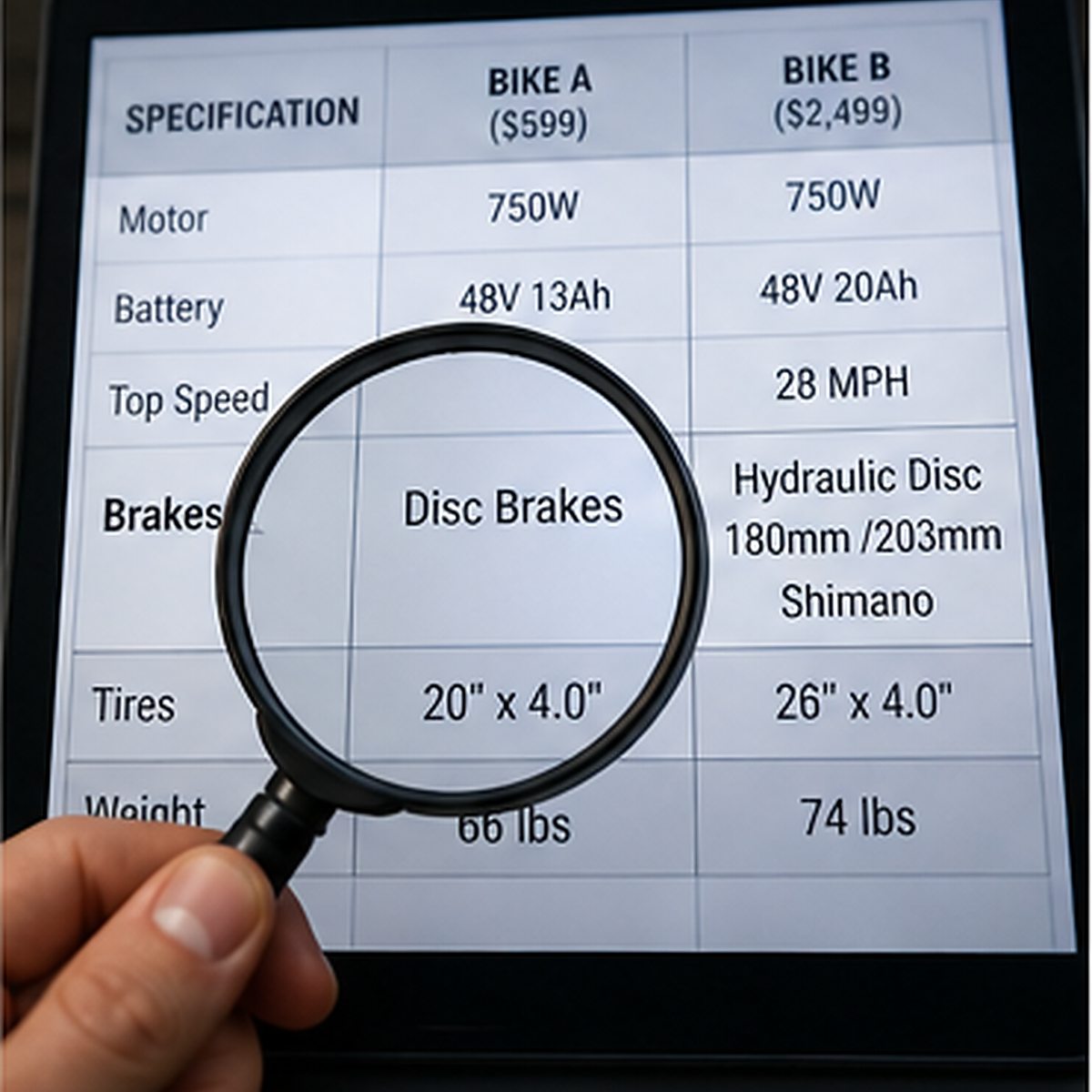
A product listing that only says "dual disc brakes" is giving you the category, not the useful details. It is like saying a car has "tires." Okay - but what kind, what size, and can you replace them easily?
A clear e-bike listing should tell you at least some of the following:
Mechanical disc, hydraulic disc, or cable-actuated hydraulic.
Usually shown in millimeters, such as 160mm, 180mm, or 203mm.
Shimano, Tektro, Zoom, Logan, Nutt, Bengal, or another named system.
Pad shape, part number, or a clear brake model you can search later.
If a bike is marketed for hills, cargo, fat tires, off-road riding, or high speed, the brake specs should be more detailed - not less.
Hydraulic vs. Mechanical: Understanding the Tradeoff
There are three common brake descriptions shoppers will see. None of them are "bad," but they fit different use cases.
Mechanical disc brakes
A steel cable runs from the brake lever to the caliper. They are affordable, simple, and easier for many riders to adjust at home.
Hydraulic disc brakes
Fluid pressure replaces the cable, usually bringing stronger stopping power, smoother lever feel, and better modulation with less hand effort.
Cable-actuated hydraulic brakes
The lever pulls a cable, but the caliper uses hydraulic action. Some riders like them as an upgrade, but they are not the same as a full hydraulic system.
If the listing is excitedly bragging about a 750W motor, throttle, and 28 mph performance, but the brakes are only described as "disc brakes," check closer. Powerful motors pair best with brakes that can confidently and consistently manage that speed and weight.
Rotor Size: The Number Shoppers Can Actually Check
Rotor size is one of the most useful brake specs because it is often visible in the listing or printed right on the metal disc of the bike. Common sizes include 160mm, 180mm, and 203mm.
Why does the size matter? It comes down to two things: leverage and heat.
More braking leverage
A brake rotor is essentially a lever. The center of the wheel is the fulcrum. The farther from the center the brake pad squeezes, the more leverage you have. It is like using a longer wrench to loosen a tight bolt: less force is required at your hand to stop the wheel.
Better heat management
Braking converts your forward momentum into heat. E-bikes are heavier and faster than standard bicycles, so they generate more heat when stopping. A larger rotor has more metal mass to absorb heat and more surface area to dissipate it into the air. If a rotor gets too hot, the brake fluid can boil or the pads can glaze over, leading to brake fade.
Is there a rule of thumb for rotor size?
There is not a strict mathematical ratio, but there is a clear relationship between total system weight (rider + bike + cargo), speed, terrain, and the rotor size you will want to look for. Tire size matters indirectly: fat tires add weight and have massive grip, meaning you can brake harder before the tire skids, which generates even more heat.
Front vs. rear, and the dual disc question
You might notice that the front rotor is often larger than the rear. When you brake, weight transfers forward. The front wheel bears up to 80% of the braking load, so the front brake does the vast majority of the stopping. The rear wheel gets lighter during braking, and a massive rear rotor can make it too easy to lock up the back wheel and skid.
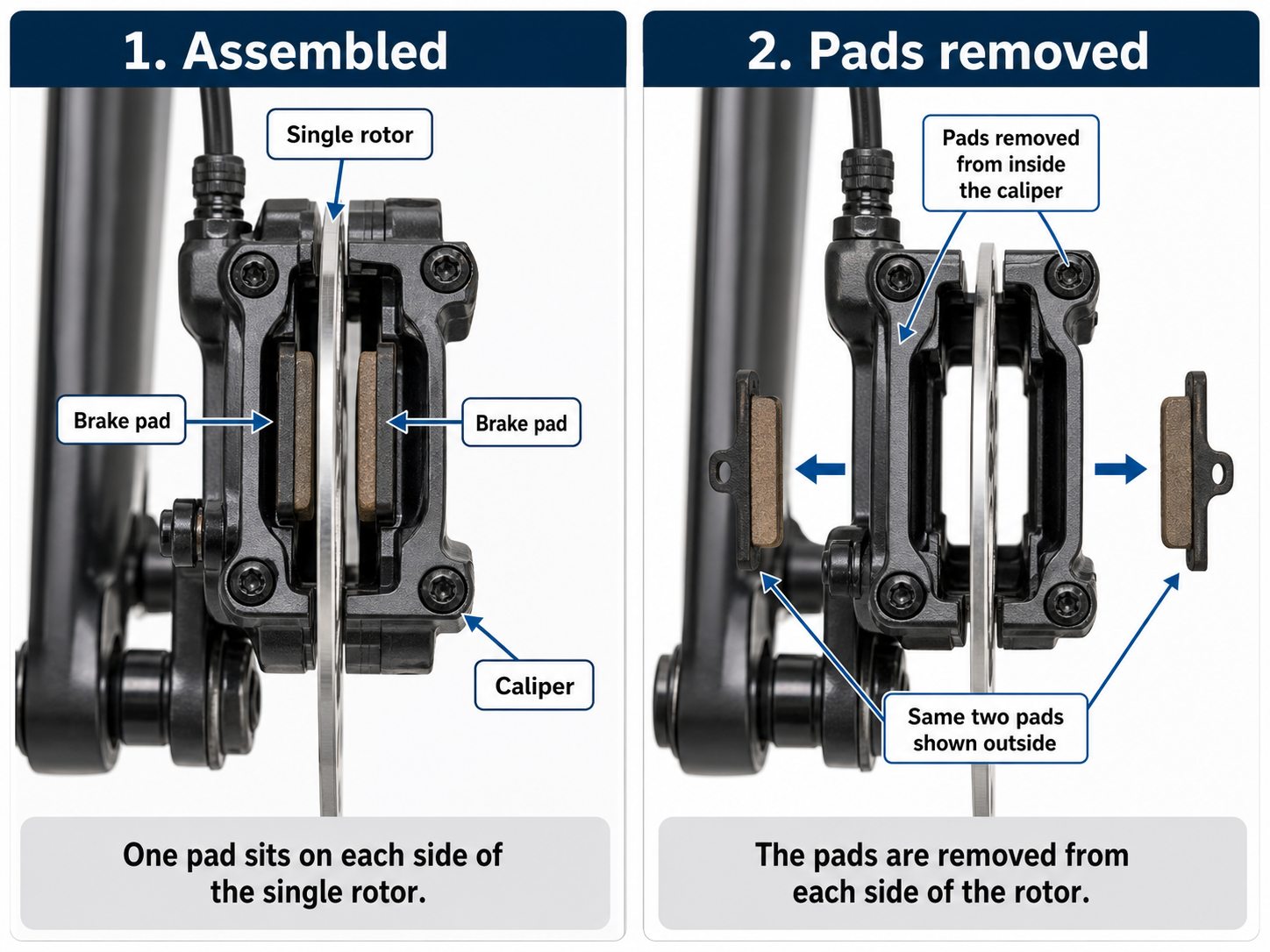
What about dual discs, meaning two rotors on one wheel? Unless you are looking at a very heavy e-cargo bike or a dedicated downhill e-MTB, dual discs are usually unnecessary for most riders. A single 203mm rotor paired with a modern 4-piston caliper provides plenty of stopping power.
The best message here is not "buy the biggest rotor." It is: look for the rotor size. If the listing does not show it, ask.
Serviceability: What Happens When the Pads Wear Out?
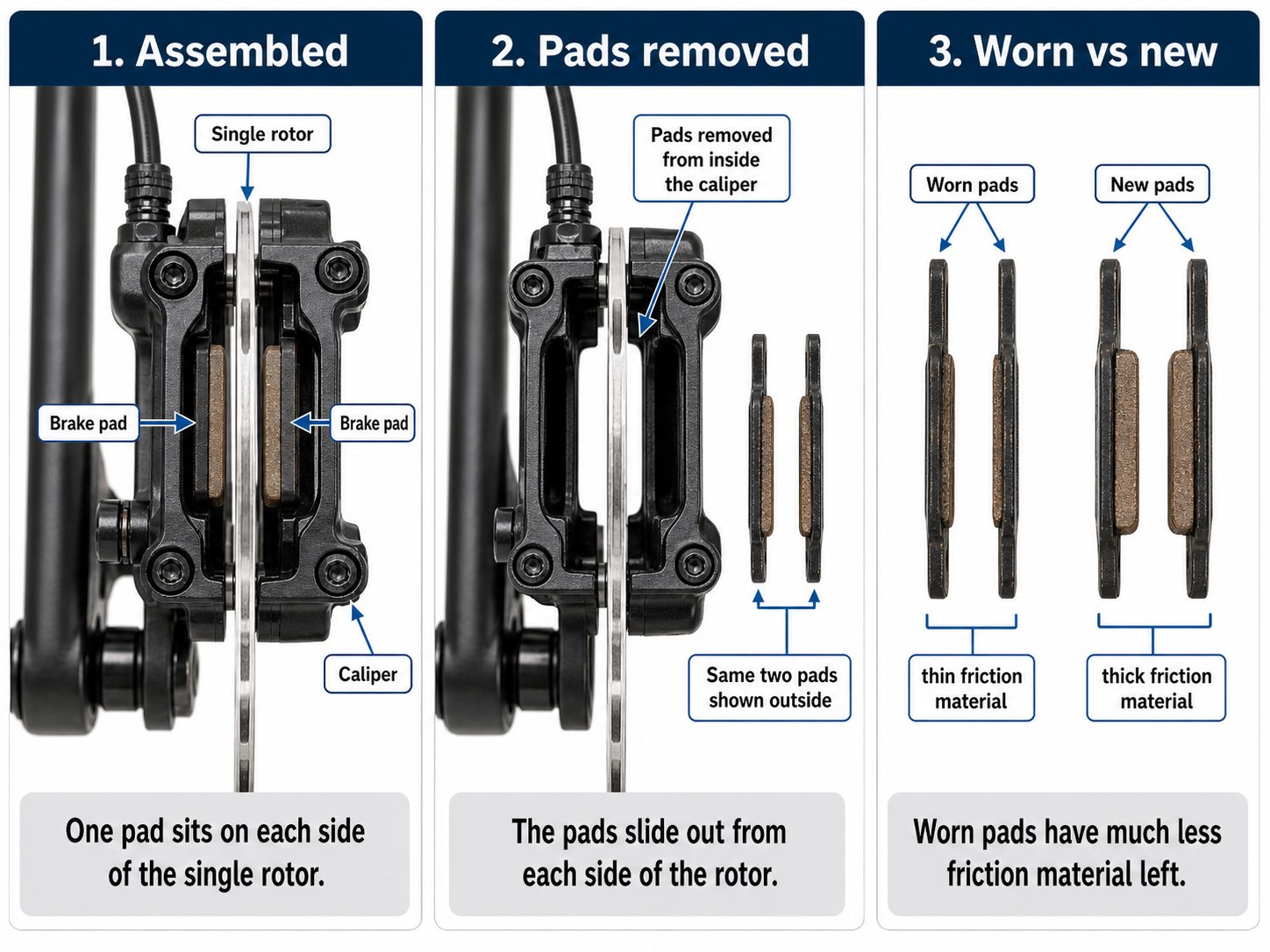
Brake brand and model may not sound exciting while shopping, but they matter enormously later. Brake pads are consumables. They wear down. And because e-bikes are heavier and often ridden faster, they wear through pads faster than acoustic bikes. Hills, rider weight, cargo, wet conditions, and stop-and-go commuting all increase wear.
This is where brake model information becomes a practical ownership issue.
If the bike uses a known brake model, like a specific Shimano or Tektro, you can usually search the model and find compatible pads in minutes. Major brands publish compatibility charts so you know exactly what to buy.
If the bike uses unbranded or obscure calipers and the listing just says "disc brakes," replacing the pads can turn into a frustrating guessing game. Too many e-bike owners find themselves removing the pads, photographing them, measuring them, and posting in forums hoping someone online recognizes them.
A shopper should be able to ask: "When these pads wear out, what do I buy?" If the answer is clear, that is a great sign of a serviceable bike. If the answer is vague, that is a tradeoff to understand before checkout.
Quick check
The Shopper's Brake Checklist
Before buying an e-bike - especially a lower-cost, high-speed, fat-tire, cargo, or off-road model - run through this quick check:
Does it name the brake type?
"Hydraulic disc brakes" or "mechanical disc brakes" is better than just "disc brakes."
Does it list rotor size?
Look for 160mm, 180mm, or 203mm. If the bike is heavy or speed-focused and the rotor size is hidden, ask the seller.
Does it name the brand or model?
A known brake model makes it easier to find pads, parts, setup guides, and shop support later.
Can you identify replacement pads?
Look for a pad part number, brake model, or seller parts page.
Does the setup match the marketing?
Power and speed are exciting. Clear brake specs are what help you manage that speed confidently.
For e-bike shoppers, the best brake question is not simply "hydraulic or mechanical?"
The better question is: Can I tell what brakes this bike has, what rotor size it uses, and how I will replace the pads later?
A clear brake listing signals that the seller expects the bike to be serviced and maintained. A vague listing does not automatically mean the bike is a bad fit, but it does mean the buyer should slow down, ask questions, and verify the details before purchasing.
Ebike Signal helps you read the signals before you ride, buy, or compare.